



EPDM Edge Seal: The Engineered Solution for Edge Protection, Sealing, and Finish
Sharp, exposed edges on sheet metal, glass, and plastic panels present a persistent challenge across virtually every manufacturing sector. An unfinished edge can cut assemblers, generate wind noise on a vehicle, allow water ingress into an electrical enclosure, or simply look cheap and incomplete. The most elegant and cost-effective solution is a precisely extruded rubber edge seal. And when that application demands decades of outdoor durability, constant vibration damping, and a secure grip without adhesives, EPDM edge seals become the material of choice. These continuous profiles, often reinforced with an embedded metal carrier or designed with a self-gripping internal structure, push onto a raw edge and stay there-protecting, sealing, and finishing in one automated operation. This comprehensive guide, written for OEM design and procurement teams, covers the material science, profile geometry, application landscape, key physical properties, and the answers to the most pressing manufacturing questions about custom EPDM edge seals.
Why EPDM is the Material of Choice for Edge Seals
Edge seals operate in a uniquely demanding stress environment. They are constantly stretched and compressed as they bend around corners, must maintain a firm grip even as the underlying substrate expands and contracts with temperature, and are frequently positioned at the outermost boundary of the product-fully exposed to sun, rain, road salt, and industrial cleaning chemicals. EPDM (Ethylene Propylene Diene Monomer) thrives under these conditions for several fundamental reasons:
Unrivaled Weathering and Ozone Resistance: The fully saturated polymer backbone of EPDM contains no reactive double bonds, making it inherently immune to ozone cracking and oxidative degradation. An EPDM edge seal installed on a rooftop HVAC unit or a truck door will remain flexible and crack-free after decades of direct UV exposure.
Broad Temperature Resilience: With a continuous service range of -50°C to +150°C, EPDM maintains its grip and elasticity in Arctic cold-where some plastics become brittle-and under the hood of an industrial oven where temperatures can spike well above boiling water. The material does not soften excessively or creep out of position.
Excellent Elastic Recovery and Compression Set: The metal carrier provides the initial bite, but the rubber must continue to press against the panel to seal out water and dampen vibration. Premium EPDM compounds deliver compression set values below 20%, meaning the rubber pushes back year after year, compensating for the micro-movements and thermal cycling that afflict any assembly.
Chemical and Water Resistance: EPDM is highly resistant to water, steam, many polar solvents, and brake fluids. It does not swell or lose strength when exposed to rain, car washes, or the alkaline cleaning agents used in food processing plants. (It is not recommended for sustained contact with petroleum oils and fuels, for which NBR or PVC/NBR blends would be specified.)
Processability and Cost-Effectiveness: EPDM extrusions can be manufactured as dense solid profiles, soft closed-cell sponge, or complex co-extrusions with a rigid carrier-all using established, high-speed microwave curing lines. Compared to silicone, EPDM offers higher tensile and tear strength at a significantly lower raw material cost, allowing thinner walls and more aggressive gripping geometries.
Types of EPDM Edge Seal Profiles
The term "edge seal" encompasses a broad design vocabulary, each geometry solving a specific mechanical and sealing challenge. The choice depends on panel thickness, edge condition, installation method, and performance requirements.
U-Channel and Self-Gripping Metal Reinforced Profiles
This is the quintessential edge seal: a U-shaped profile with an internal steel or aluminum carrier. The carrier consists of a continuous wire or segmented metal band formed into small, inward-facing prongs. When the profile is pressed onto a panel edge, these prongs bite into the surface, holding the seal firmly in place without the mess or long curing time of liquid adhesives. Key variants include:
Full Metal Core: A continuous U-shaped steel wire spine that provides high clamping force for heavy-duty applications such as tractor fenders, machine guarding, and marine hatch edges.
Segmented Metal Carrier: Stamped metal clips embedded at regular intervals allow the profile to bend easily around tight radius corners without buckling-essential for automotive door frame edges and curved glass panels.
Wire Harness Edge Trim: A fine, flexible wire carrier that provides a gentle grip for interior trim applications, instrument panels, and consumer appliance edges.
Bulb and Bubble Edge Profiles
When the primary function shifts from mere edge protection to dynamic sealing against a mating surface, an integrated hollow bulb is added to the U-channel base. As a door or hatch closes, the bulb compresses, forming an airtight and watertight barrier. These profiles are widely used on:
Automotive door edges that must seal against the body aperture.
Access panels on outdoor telecom enclosures.
Refrigeration and freezer door perimeters where thermal insulation is critical.
Lip and Flap Edge Seals
A flexible co-extruded lip extends from the gripping section to contact an adjacent surface. This lip can be a simple dust shield, a water deflector, or an acoustic barrier. Dual-lipped edge seals on sliding glass panels create a labyrinth that prevents wind noise and water penetration. The lip can be formulated with a lower Shore A hardness than the gripping body for better conformability without compromising retention.
Sponge and Foam Edge Trim
Closed-cell EPDM sponge profiles are used where the edge must be surrounded by an extremely soft, compressible material-for example, to prevent rattle between a plastic dashboard and a steel cross-car beam, or to provide a thermal break on a metal window frame edge. The sponge structure compresses effortlessly, filling irregular gaps without transmitting significant force to the substrate.
Co-Extruded Rigid-Flexible Profiles
A rigid EPDM or polypropylene carrier section is co-extruded with a softer EPDM sealing element. The rigid part snaps or slides into a pre-formed groove in the panel, while the soft part performs the edge sealing. This approach completely eliminates metal, ideal for all-plastic assemblies in corrosive environments such as chemical plants or coastal installations. It also enables continuous push-in assembly on automated lines.
Key Applications Across Industries
EPDM edge seals are a unifying component, finding use wherever sheet metal, glass, or composite panels meet the outside world-or where a sharp edge needs to be rendered safe and attractive.
Automotive and Commercial Vehicles. The modern vehicle contains dozens of individual edge seal part numbers. Door flanges, sunroof openings, running board edges, wheel arch lips, and engine bay panels all receive custom EPDM edge trim. These parts must pass rigorous testing: thousands of door slam cycles without dislodging, resistance to hot wax and phosphate during the e-coat process, and zero squeak-and-rattle contribution measured on a four-poster shaker rig. In electric vehicles, edge seals on battery tray flanges provide IP67 protection, preventing water and dust intrusion during the vehicle's entire lifetime.
Building and Architectural Systems. Metal roofing systems employ EPDM edge seals to close the gap between standing seam panels and the building parapet, while curtain wall contractors use them to cover the raw cut edges of aluminum mullions and glass fins. Rooftop solar panel frames often integrate push-on edge seals to prevent wind-driven rain from corroding electrical connections underneath the panels. These architectural seals are engineered to retain their grip and color through 30 years of full-spectrum sunlight.
Industrial Enclosures and Cabinetry. Electrical cabinets, server racks, and outdoor equipment housings must achieve NEMA 4 or IP66 ratings. A continuous EPDM edge seal, applied to the door or body flange, forms the primary environmental barrier. In food processing and pharmaceutical equipment, metal-detectable EPDM edge seals are specified so that any piece of accidentally severed trim can be identified and removed by inline X-ray or metal detection systems, meeting HACCP requirements.
Marine and RV. The edge of a boat's engine hatch or a recreational vehicle's storage compartment door is constantly exposed to salt spray, vibration, and physical abuse. EPDM edge seals, often with a marine-grade stainless steel carrier, provide corrosion-proof grip and seal integrity. Below-deck applications frequently use fire-retardant EPDM edge profiles that meet the U.S. Coast Guard's flammability standards for interior materials.
Appliance and Agricultural Machinery. White goods such as washing machine lids and dryer drums feature EPDM edge seals that dampen vibration and prevent water leaks. In combine harvesters and construction equipment, large EPDM edge trims protect operators from sharp metal edges in the cab and seal out dust, crop chaff, and hydraulic fluid mist.
Physical Properties Table: EPDM Edge Seal Compounds
The following table presents the typical physical properties for solid and sponge EPDM compounds formulated for edge seal applications. Values are influenced by the specific hardness, filler package, and cure system selected. Custom formulations can be developed to meet specific OEM material standards, including ASTM D2000 line call-outs, GM, WSS-M, and other automotive specifications.
| Property | Test Standard | Unit | Solid Dense (Grip/Lip) | Closed-Cell Sponge (Edge Trim) |
|---|---|---|---|---|
| Hardness / Density | ASTM D2240 / D1056 | Shore A / kg/m³ | 50 – 80 Shore A | 400 – 650 kg/m³ |
| Tensile Strength | ASTM D412 | MPa (psi) | ≥ 8.0 (1160) | ≥ 0.5 (70) |
| Elongation at Break | ASTM D412 | % | 200 – 450 | 100 – 200 |
| Compression Set (22h @ 70°C, 25% defl.) | ASTM D395 Method B | % | ≤ 20 | ≤ 35 |
| Compression Set (24h @ 100°C) | ISO 815-2 | % | ≤ 35 | ≤ 50 |
| Tear Resistance | ASTM D624 Die C | kN/m | 18 – 35 | 3 – 8 |
| Low-Temp. Brittleness | ASTM D2137 | °C | -50 pass | -40 pass |
| Ozone Resistance (50 pphm, 40°C, 96h, 20% strain) | ASTM D1149 | Rating | No cracks | No cracks |
| UV Resistance (Xenon arc, 1000h) | ASTM G155 | Rating | No surface change | Minor color change |
| Water Absorption | ASTM D471 | % by mass | < 2 | < 5 |
| Flammability | FMVSS 302 / UL94 | Rating | SE / HB (V-0 formulated) | HF-1 / V-0 formulated |
| Service Temperature Range | Continuous | °C | -50 to +135 | -40 to +120 |
Note: The gripping performance of a metal-reinforced edge seal is characterized not only by the rubber compound but by the carrier design (wire diameter, prong geometry, segment pitch). Pull-off force values are typically specified between 50–200 N per 100 mm length, depending on panel thickness and surface roughness. For applications requiring oil resistance (e.g., hydraulic equipment edges), EPDM/PVC or NBR/PVC blends are available and will show different property values.
Features
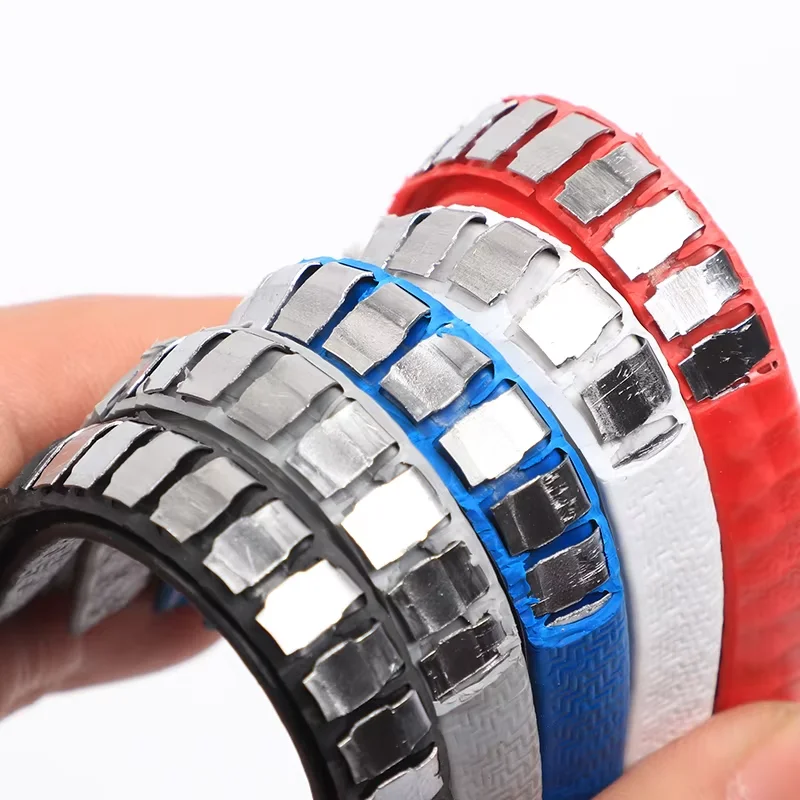
1. Elastic Recovery
Returns quickly after stretching and compression, maintaining shape stability under repeated deformation.
2. Insulation Properties
Blocks electrical conduction, ensuring safe isolation between conductive parts.
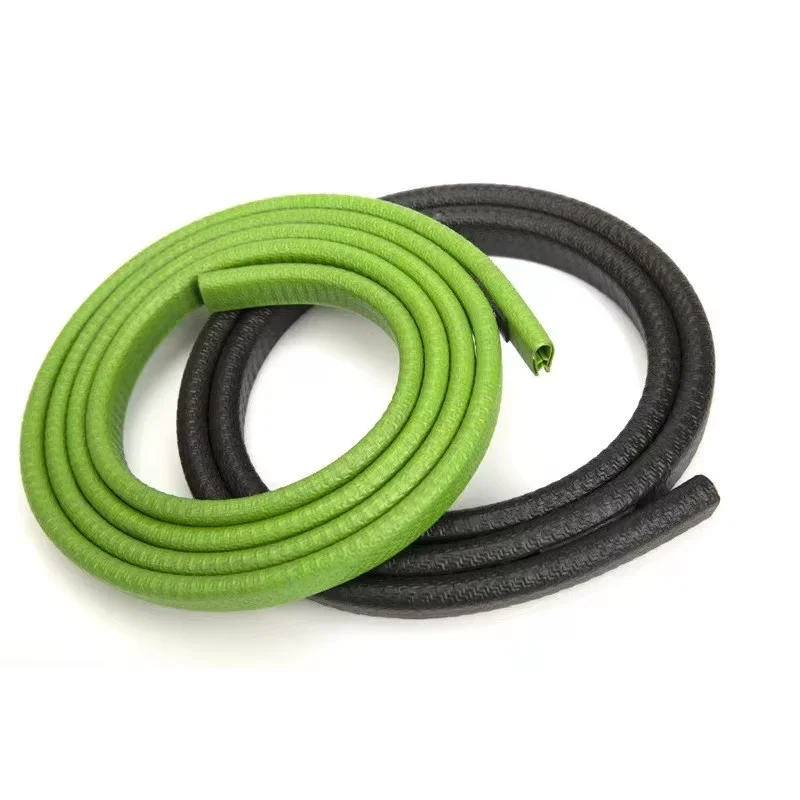
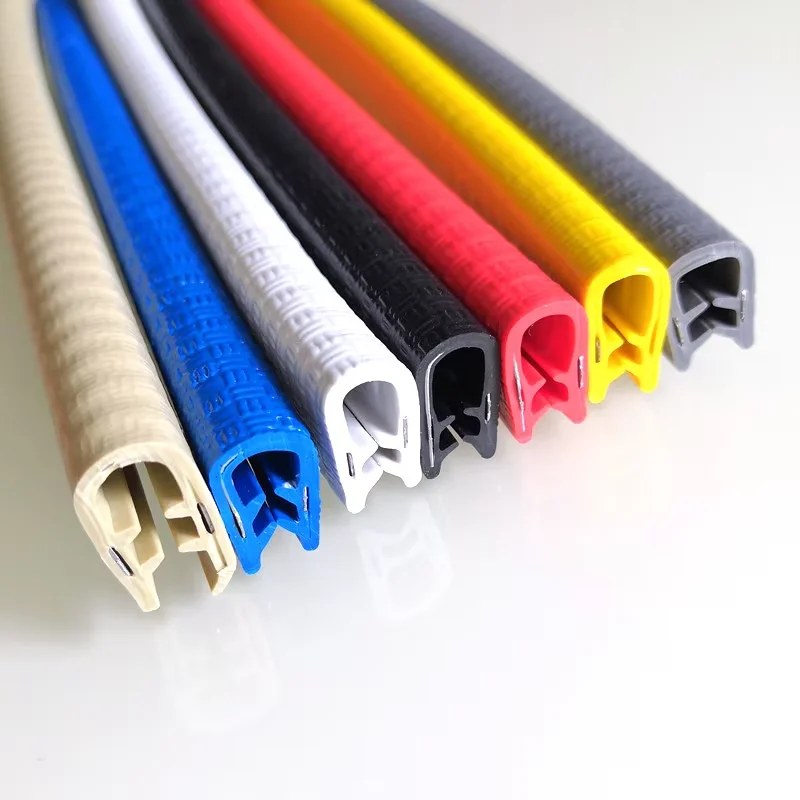
3. Chemical Stability
Resists automotive fuels, solvents, and ozone exposure without cracking or material degradation.

Design and Specification Guidance for OEMs
Integrating an EPDM edge seal into a product requires a holistic view of the panel edge condition, installation process, and in-service stress profile.
Panel Thickness and Edge Condition. The single most critical dimension is the substrate thickness over which the seal must be mounted. Edge seals are specified with a nominal grip range (e.g., 1.0–2.5 mm). For painted or coated panels, the grip range must account for the coating thickness. The edge radius also matters: a sharp, burr-free edge allows a cleaner bite from the metal carrier, while a rounded edge may require a deeper internal barb design to prevent walk-off. Providing a panel sample along with the profile drawing is standard best practice during tooling development.
Installation Force and Retention. The push-on force must be manageable for a human operator or an end-of-arm robot tooling, yet the retention force must be high enough to prevent the seal from loosening under vibration. This force balance is tuned by adjusting the carrier steel hardness, prong angle, and rubber wall thickness. Typical installation force targets range from 5–15 N per 100 mm for hand-assembled interior trims, up to 40 N for heavy industrial seals. We provide force-deflection curves measured on an Instron machine, simulating both installation and pull-off, as part of the part submission warrant (PSW).
Corner Design: Notching, Molding, or Mitering. An extruded edge seal traveling around a sharp 90° corner will naturally buckle on the inner radius. There are several remedies:
Precision notching: V-shaped cuts on the internal leg of the profile allow it to bend without puckering the outer sealing surface. This is cost-effective for large-radius bends.
Injection-molded corners: A 90° or custom-angle corner piece is molded and vulcanized directly onto the extruded lengths, creating a seamless, perfectly formed corner with uniform grip and appearance.
Miter cutting and splicing: The ends are cut and bonded for picture-frame applications. The tooling strategy is determined during the DFM review based on the bend radius, production volume, and aesthetic requirements.
Material Identification and Process Compatibility. For automotive OEMs, the EPDM compound must survive the entire body-in-white and paint shop process. High-temperature solid EPDM grades can withstand the e-coat cure oven temperatures (180–200°C for up to 30 minutes) without significant surface degradation or loss of grip. We conduct rheometer (MDR) and thermogravimetric analysis (TGA) on every batch to guarantee cure consistency and heat stability. Parts are supplied with barcode or QR-code labels mapping directly to these quality records.
Frequently Asked Questions (FAQ) – Tailored for OEMs
1. Can you develop a fully custom EPDM edge seal for our specific panel thickness and corner geometry, and what does the tooling and sampling process entail?
Yes, developing custom edge seals to match a unique panel edge is our core business. We start with your panel drawing (or a physical sample), define the grip range, sealing lip if required, and corner radius. A cross-section die and a metal carrier forming tool are designed. Within 2–3 weeks, first-article extrusion samples are produced on a trial run and shipped to you for fit and retention force testing on your actual panel. We then refine the tooling iteratively at no additional tooling charge for minor adjustments until the seal meets your assembly and performance specifications. Only upon your written sample approval do we proceed to production tooling and PPAP submission.
2. What are your minimum order quantities (MOQs) for custom EPDM edge seals, and can you support lean manufacturing with just-in-time deliveries?
MOQ is tailored to the complexity of the profile and the type of carrier. For a standard U-channel edge seal in black EPDM, MOQ can be as low as 1,000 meters. For customized colors, specialty flame-retardant compounds, or co-extruded rigid-flexible designs, MOQs typically start around 2,000 meters. To support your lean production, we offer blanket order releases with Kanban pull signals and JIT delivery in returnable packaging that integrates with your line-side racks. We can hold a consignment stock of your finished seal in our warehouse and ship against a rolling weekly forecast, ensuring zero assembly line downtime.
3. How do you ensure batch-to-batch consistency and provide the documentation required for our automotive or industrial certifications (PPAP, IMDS, etc.)?
Every batch is manufactured under a controlled production process and released with a Certificate of Analysis (COA) listing hardness, tensile strength, elongation, compression set, and specific gravity. For automotive programs, we submit a full Production Part Approval Process (PPAP) package, typically Level 3, which includes dimensional layout, material and performance test results, process FMEA, control plan, and capability studies (Cpk ≥ 1.33) on critical grip dimensions. We populate the International Material Data System (IMDS) with the exact formulation of your compound and provide a fully traceable batch genealogy back to the raw polymer and steel coil lot numbers.
4. What tolerances can you hold on the critical gripping dimensions of an extruded edge seal to ensure consistent automated push-on assembly?
We manufacture to ISO 3302-1 Class E2 for the overall rubber profile and tighter, monitored tolerances for the internal metal carrier spread. The gap between the internal gripping prongs can be controlled to ±0.15 mm for a good process capability. In-line laser measurement continuously monitors the cross-section, and a go/no-go push-on gauge test is performed at the start, middle, and end of every production run on production-intent panel samples. For automated robotic installation, we provide a detailed dimensional report and fixture the seal on a representative panel section so your manufacturing engineers can validate robot path and insertion force parameters before mass production.
5. What value-added services are available to deliver a ready-to-fit edge seal that reduces our in-house secondary operations?
We offer a complete suite of conversion services to streamline your assembly process:
Pre-cut and notched lengths supplied in kit packs sequenced to your build order.
Vulcanized injection-molded corners for complex window or door frame geometries, providing a seamless, all-rubber 90°, 180°, or custom-angle corner with no visible joint and no adhesive.
Applied pressure-sensitive adhesive tape on the internal leg (for additional retention on low-friction plastic panels) or on the outer surface for bonding to a secondary component.
Flock coating or PTFE-impregnated surfaces on the sealing lip to reduce friction against glass and painted surfaces, eliminating squeaks and the need for separate lubricant application.
Pad printing or laser marking of part numbers, date codes, and customer logos for complete traceability and brand visibility.
Hot Tags: epdm edge seal, China epdm edge seal manufacturers, suppliers, factory, vehicle container sealing gaskets, t section rubber seal, epdm flame retardant rubber strip, 3mm epdm rubber, u rubber edge trim, epdm rubber rods