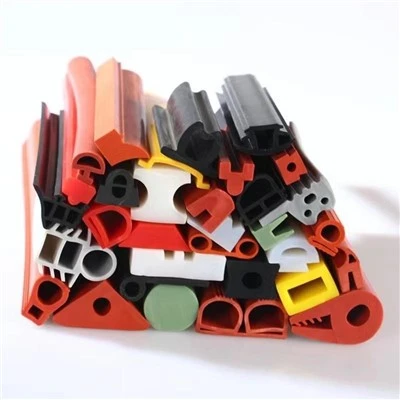
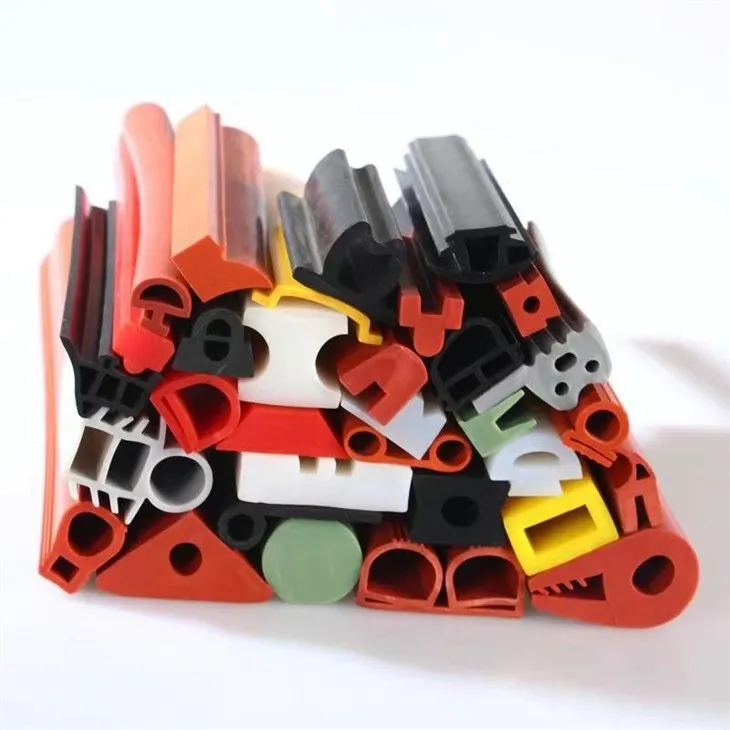
A profile is not a shape. It is a set of functions packed into one continuous cross-section.
A silicone rubber profile is a custom extruded section designed to perform several jobs along one continuous length: seal against a surface, grip an edge, locate into a groove, compress under load, and recover when the load is released. The cross-section is where those functions are resolved. A single profile can combine a U-shaped mounting channel, one or more flexible sealing lips, a hollow compression bulb, retaining ribs and positioning grooves - features that would otherwise require several separate parts and assembly steps[reference:0]. What separates a profile that works from one that fails is not how complex the drawing looks, but whether the geometry can be extruded with balanced material flow, hold its shape before cure, and repeatedly meet the dimensions that matter to the seal. We manufacture custom silicone rubber profiles up to 80 × 80 mm section, in 40–80 Shore A, at our ISO 9001:2015 facility in Jinjiang, Fujian, working from a drawing or a physical sample[reference:1].
What a profile cross-section can integrate
Sealing lips and compression bulbs
The sealing function is carried by a lip that flexes against the mating surface or a hollow bulb that compresses and recovers. A multi-lip profile creates several contact lines within one extrusion, giving redundancy that a single flat strip cannot match[reference:2]. The lip thickness and bulb wall are the dimensions that set the sealing force.
Mounting channels and retaining ribs
The mounting function is carried by a U-channel, a keyhole slot or a pair of retaining ribs that grip a panel edge or seat into a groove. This is what allows the profile to stay in position without adhesive, and it is often the feature that determines whether the profile can be installed at all[reference:3].
Positioning grooves and locating features
A groove or a small locating rib sets the depth or the orientation of the profile relative to the frame. It is the feature that prevents the seal from being pushed too far into a gap or installed upside down, and it is the one most often omitted from a first drawing.
Silicone rubber profile specifications
| Material | Silicone rubber (VMQ); solid dense or sponge, depending on profile |
|---|---|
| Section size | Up to 80 × 80 mm (width × height); larger by agreement |
| Hardness | 40–80 Shore A standard; 65 Shore A typical for compact silicone profiles[reference:4] |
| Temperature range | −60 °C to +230 °C standard; special formulations to −90 °C / +315 °C[reference:5] |
| Tensile strength | 7–12 MPa |
| Elongation at break | ≥250% |
| Density (solid) | ≈1.20 g/cm³ |
| Dimensional tolerance | ISO 3302-1 Class E2 as standard; tighter by agreement on critical sealing features |
| Colours | Translucent, white, black, grey, red, green, yellow, blue as standard; custom matching on request[reference:6] |
| Surface | Glossy standard; matte or textured by agreement |
| Certification | ISO 9001:2015; food-grade and medical-grade compounds available |
Values are for standard compact silicone profile compounds. Sponge profiles carry different density and hardness ranges - confirm the compound form against the compression duty before a production order.
What makes a profile difficult to extrude - and how to design around it
The number of features alone does not determine whether a profile is difficult to produce. A section with several relatively thick, balanced walls can be easier to extrude than a simpler section that combines one heavy wall with a very thin unsupported lip[reference:7]. The rules below are the ones that most often decide whether a drawing becomes a stable production profile.
| Design factor | Why it causes problems | Practical rule |
|---|---|---|
| Wall thickness variation | Silicone must reach different regions of the die at a uniform flow rate; a heavy section beside a thin lip cures at a different rate and can distort | Keep adjacent wall thickness within roughly 2:1; balance the flow across the die cross-section[reference:8] |
| Sharp internal corners | Sharp corners create dead zones in the die and stress concentrations in the cured profile | Radius internal corners; avoid sharp corners and sudden changes in flow direction[reference:9] |
| Long unsupported lips or fins | A thin isolated fin is difficult to support after the die and can sag or tear before cure | Increase the root thickness of the lip, or support it with a web; avoid extremely thin isolated fins[reference:10] |
| Hollow chambers | Hollow sections can collapse before cure or trap air if not vented and supported | Confirm collapse resistance, venting and compression direction on the drawing[reference:11] |
| Asymmetric sections | Uneven mass distribution causes the profile to bow or twist as it cures | Define acceptable bow, twist and coil set tolerances for the assembly; consider a symmetric section if possible[reference:12] |
These rules do not eliminate complex profiles. They make the difference between a profile that can be quoted confidently and one that requires trial runs to stabilise.
Drawing review before tooling: send the cross-section with critical dimensions marked. We review flow balance, wall thickness and feature support before cutting the die, and flag features that would add tooling cost without improving the seal.
Tolerance and compression: the two numbers that decide fit and sealing
A profile has two performance limits that are independent of the compound: the tolerance on the dimensions that mate with the frame, and the compression ratio at the sealing face. Both are set by the drawing, not by the material datasheet.
| Parameter | Standard / target | What it controls |
|---|---|---|
| Sectional tolerance | ISO 3302-1 Class E2; tighter by agreement | Whether the profile fits the groove or frame without forcing or rattling |
| Wall thickness tolerance | Per ISO 3302-1 table, typically ±0.35–0.80 mm depending on nominal thickness | Sealing lip thickness and compression force consistency |
| Compression ratio | 30–40% recommended; 50% maximum for a sealing profile[reference:13] | Whether the lip develops enough contact force without taking a permanent set |
| Compression set | Low; good silicone extrusion compounds measure ~3.0% at 70 °C[reference:14] | Whether the profile recovers after the joint opens |
E2 is a reasonable tolerance for a groove designed for extruded profile. It is not sufficient for a gland designed for a moulded part. If the groove is tight, specify a tighter class on the critical dimensions or reconsider the profile form.
A profile compressed beyond 50% is not a better seal. Over-compression accelerates compression set and can prevent the lip from recovering, which opens a gap when the joint moves. The 30–40% band is the working range; a joint that requires more than 50% compression needs a different profile, not a harder compound.
Data we need to quote a silicone rubber profile
The quote depends on the cross-section, the compound and the secondary operations - not on a material name alone. Send the following:
- Cross-section drawing: all dimensions, with critical-to-function dimensions and tolerance classes marked; a physical sample is acceptable for reverse engineering.
- Compound form and hardness: solid dense or sponge; 40–80 Shore A target; and whether a food-grade or medical-grade compound is required.
- Compression duty: the installed gap, the compression ratio and the force the frame or latch can accept.
- Environment: temperature range, UV/ozone exposure, and any oil, solvent or chemical contact.
- Secondary operations: cut-to-length, splicing into rings or frames, punched holes, adhesive backing or moulded corners.
- Annual quantity and colour: the volume per profile, and whether a standard or matched colour is required.
We will confirm the compound, die feasibility and tolerance plan against the drawing, and supply a sample length for fit and compression check before production. MOQ is from 10 kg for standard profiles[reference:15].
Quality control and supply
We manufacture silicone rubber profiles at our vertically integrated facility in Jinjiang, Fujian, under ISO 9001:2015. Silicone compound is mixed in-house, so hardness, cure system and colour are controlled from raw material. Extruded profiles are checked for cross-section dimensions, wall thickness, surface finish and straightness, and each batch is sampled for hardness (ASTM D2240), tensile strength and elongation (ASTM D412) and compression set (ASTM D395). Profiles that require secondary operations are checked for joint strength and dimensional fit after cutting or splicing. Finished coils or cut lengths are labelled with batch number, compound reference, profile code and dimensions. We supply industrial, automotive, construction and appliance customers in over 30 countries. Port of loading is Xiamen.
Related silicone profile and extrusion products
- Silicone rubber extended products - profiles, gaskets, cords and tubing
- Silicone seal strip - solid flat and profiled sections
- Silicone rubber cord - solid VMQ round cord
- Silicone rubber sponge strip - closed-cell profiles
- Silicone molding - custom moulded parts
- About our rubber manufacturing
- Contact the profile engineering team
Silicone rubber profiles - buyer FAQ
A silicone seal strip is typically a flat or simple rectangular section supplied as base stock, cut and fitted on site. A silicone rubber profile is a custom cross-section designed to perform a specific function in the joint - a mounting channel that grips an edge, a sealing lip that compresses against a surface, a hollow bulb that recovers after load, or a combination of these in one extrusion. The profile is engineered to the frame and the sealing duty, while a strip is a general-purpose material. The distinction matters because the tooling, tolerance and drawing review are different for a profile.
Complexity is not measured by the number of features. A profile can combine a U-channel, multiple sealing lips, a hollow bulb, retaining ribs and locating grooves and still be extrudable if the wall thickness is balanced and the material flow across the die is uniform. The difficult combinations are the ones with a heavy section beside a very thin unsupported lip, sharp internal corners, long isolated fins, or asymmetric mass distribution that causes bow and twist. The practical test is whether the geometry can be extruded with balanced flow and hold its shape before cure, not how detailed the CAD file looks.
The recommended working range for a sealing profile is 30–40% compression, with 50% as the maximum. Below 30%, the lip may not develop enough contact force to seal at the widest gap; above 50%, compression set accelerates and the lip may not recover when the joint opens. The exact target depends on the lip thickness and the hardness, but the band is a useful constraint at the drawing stage. If the joint requires more than 50% compression, the correct response is a different profile geometry, not a harder compound.
ISO 3302-1 Class E2 is the standard extrusion tolerance for rubber profiles, and it is the default for our silicone profiles. E2 is adequate for a groove designed around an extruded section, but it is wider than the tolerance of a moulded part. For critical sealing features - a lip thickness, a groove width or a mounting channel opening - we can work to a tighter class by agreement, provided the drawing marks which dimensions are critical. Specifying E2 across every dimension on a profile is usually unnecessary and adds cost without improving the seal.
MOQ is from 10 kg for standard silicone profiles. A custom die, a sponge or food-grade compound, or a fabricated assembly carries a higher minimum because the tooling and compound run are dedicated. Sample lead time depends on whether a die already exists; a new die adds fabrication and sampling time before production. Send the cross-section drawing, compound form and hardness, annual quantity and required date, and we will quote MOQ, tooling and schedule together.
Send your cross-section for a silicone rubber profile quotation
Share the cross-section drawing or sample, compound form (solid or sponge) and hardness, compression duty, environment and exposure, secondary operations, annual quantity and destination port. We will reply with a die feasibility review, compound recommendation, tolerance plan, sample availability, MOQ, lead time and quotation.
Hot Tags: silicone rubber profiles, China silicone rubber profiles manufacturers, suppliers, factory, Extruded Silicone Tubing, Rubber Seal Gasket Strip, Rubber Seal Strip For Oven Door, Silicone Rubber Sealant, Silicone Rubber Strips With Adhesive, Silicone Rubber Tube